Friday, 4 June 2021

Arty alternatives

John Strickland has drawn my attention to a couple of interesting techniques that are a little out of the ordinary. During his classes he has been encouraging his participants to think out of the square.


The first technique is scraperboard. 

Maybe you remember this from your school art classes? We were given a bit of black board and a sharp instrument for cutting through the black surface and revealing the white card beneath.


Things have moved on! The underlying layer can now be multicoloured. Maureen sent an impressive example of a head - see above. Of course with time perhaps the ‘arbitrary’ colour below the surface can be used to its advantage.


John thought colour and cleverly used the hues to create a Chinese dragon.


The second technique his group has been experimenting with is the effect of pouring acrylic paints. These are liquid acrylics that are thinned down and then...poured! Sounds simple and indeed it is but to create and vaguely control the pouring, dilution and direction...is an art.


There are no FHAS pictures to support this but, according to members present, it is a liberating and fun way to create colour and design.


John recommended looking at OLGA SOBY(see above)  on YouTube. She has produced some exquisite work. Have a look at what she does and maybe you, too, will be inspired.


Remember next up is the portrait challenge. Please send your works soonest!


Monday, 17 May 2021

PORTRAIT challenge

From the earliest recorded times we have portraits. And while you may consider they are a difficult theme, a portrait is essentially about observation and noting the most important and striking features on a face and putting them down on paper, canvas or wood. It is taken to its extreme in the caricature. 

You don't have to do portraits with great detail - as you will see with some of the modern portraits included here - but our greatest portrait artists usually did. More was best. 

Why do we want portraits? It is enduring. It lives longer (usually) than the person themselves. In times past, it might have been to honor a figurehead, to remember a loved one, and in the case of commissioning one's one portrait the desire to show ones self in the best light. To be remembered. To be envied. To be ... loved? It's not much different today, especially for the younger generation whose obsession with cellphone selfies has taken portraiture to new heights (and sunken to even more vain depths!).

We suggest a challenge to send in a portrait to us. 

It can be a portrait of a friend or family member, a self portrait or even an invented portrait. And you can do this is whatever medium you favour. We have a few treats already in store by FHAS members done in pencil - but don't stop there. Pick up a hat, position yourself in front of the mirror (or take a selfie) and bring us your best efforts by 05 JUNE 2021.

Below you'll see an arbitrary selection of portraits done over the last 2000 years (OK! Most of them belong to the quorum of artistic work over the last 150 years!) and it becomes obvious that as the decades pass, there is a loosening up of technique but never a diminishing of observation.

Enjoy the selection, and then get down to doing a portrait for this challenge!


Roman Emperor - he could almost be that bearded
 man that passed you in the street yesterday. 
A likeness from over 200 years ago.


Legacy from Pompeii

The man who brought us exciting portraiture,  Rembrandt. He was the first
artist to use light sources in an interesting even mysterious way.


A refined portrait by Titian, master of painting fur and exotic brocades 
- and rather good at faces too!


Another Rembrandt. Note the angle of the face: it's a winner. 
Rare are the successful portraits straight forward


What was going through Rembrandt's head in this pencil portrait of himself?


One of the greatest portraitists: John Singer Sergent. He was the favourite 
of the upper classes and certainly gave them magnificent portraits.


The juxtaposition of these two portraits by Picasso are not meant to be the same woman. 
But just look at how the master skipped from realism to modern art.Yes, it is a little difficult
to identify the sitter but... perhaps he/she recognized him/herself!


Another Picasso


                  And yet another.


Modigliani went for elongated simplicity and warm colours here,
 forging his own unique style


One of the best loved likenesses of Vincent Van Gogh.Who, but a great artist,  
would have thought of painting a beard so red! He brought feeling to painting.


As his life progressed (and his painting was curtailed by his immobility towards
the end of his life) Matisse moved towards a greater simplification


... And it doesn't get more simple. Matisse is still recognizable!


It might take all of 30 seconds to trace this simple portrait, but it probably took 
Matisse much longer to draw it.


The first camera portraits were of people standing or sitting rigidly, usually
 front forward for they had to hold their pose a while for the cameraman. 
This Grant Wood portrait harks back to that kind of photography where the subject was a little wary!


Andy Warhol remembers John Lennon - a mixture of photography and paint


Not one for prettifying his sitters (or himself in
 this case) Lucien Freudgets down to the basics with lots of shadows


I couldn't find out how Her Majesty reacted to this Freud portrait...


Utter simplicity of line and block colour


A rather tasteful 'portrait' of the ex President 


Back on home ground: the art of caricature as perfected by Zapiro.


Saturday, 15 May 2021

Following up with the latest drawings.

The theme AUTUMN didn't seem to inspire FHAS artists and we received only a few works and all are done in pencil, graphite or colored pencil.

Here they are:

John starts us off with images from his Mid Eastern travels (sadly not this year!).


Marcelle rambles locally and found this wonderful gnarled tree with its extraordinary root structure.


Ann didn't leave home for this realistic portrait. 


Maugie is lamenting the end of the summer and beginning of Autumn.


And Fiona is rejoicing in the fresh produce of the season.


Wednesday, 21 April 2021

The New Challenge: Drawing Autumn

After the blog yesterday, we received a number of drawings! THANK YOU members of Fish Hoek Art Society. We'd like more so here is a challenge.

Vincent Van Gogh


We're inviting you to send in more drawings on the theme of  Autumn. Coloured pencil, graphite, pen, chalk, ink, biro...whatever takes your fancy. 

You can do your work in one or more different media, using different tools and mixing and matching if you feel like it. It is whatever takes your fancy and on any colored paper (it is not one of those challenging with straightjacket rules!) and we'd like you to find a subject that appeals to you. 

Remember that the paper plays a big role in the success of your drawing. Some papers work much better than others - especially with pencil - and a coloured paper can give you a bit of extra pizazz (as we saw in Rob's feline portrait yesterday) especially if you used dark AND light strokes.

If Autumn doesn't sound inspirational, then give us Summer, the Sea, Trees - we really don't mind. We'd just like you to take out your sketchbook and bring something to life.

Below there are a selection of images 'borrowed' from the internet all of which were created by well known artists and illustrate different attitudes and approaches to a drawing.

We'll start with one of the most minimal works - but my goodness, if you remember how Picasso looked in his youth, you'll realise how few lines he needed to capture his own image.

Pablo Picasso


Nearly a century later, it is Lucian Freud who gives us a simple but very effective portrait. Whereas Picasso relied on line and a single dark patch, Freud uses lines and dots to sculpt her face. But, it is the clarity of those eyes with their reflected light that mesmerize us.

Lucian Freud


WMJ Turner


This bucolic sketch could have been Constable but it is that fabulous colourist, Turner. Again this is done essentially line and probably on the spot. You have cameras so if that autumnal weather looks as though it's going to take a miserable turn, snap your subject on a cellphone or camera and settle down in the comfort of your own home and bring your subject back to life.

I've always had a soft spot for this excellent French artist, below. Naturally being a woman in a man's world she was somewhat overlooked. A mistake!

What Cassatt illustrates here is that it's really only necessary to treat the important part of your subject. The bird and the woman's head. The two girls' heads closely together. She doesn't waste time on skirts or other props. 

The lesson? Work out what it is that is important, or what it is that captures your attention and give that part your best effort. 

This is an essential maxim for the creation of all works. Eliminate all that is not your theme or does not add any narrative. Think clear and clean.

Mary Cassatt

Mary Cassatt

Beatrix Potter


How could we forget this extraordinary British woman who brought us Jemima Puddleduck and Peter Rabbit (and all those other delightful characters!) Potter was an excellent artist and a good story teller. 

Above, is a simple drawing where she corrects herself without the need for a rubber. 

There is another lesson here: observe carefully and draw what you see. When you've arrived at that, darken or strengthen the lines that you want and let the others just fade into the body of the work.


Vincent Van Gogh


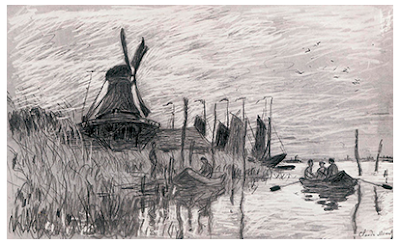
Did Van Gogh give us his best when his spirit was tortured? Perhaps. His portrait at the top of the page is a fresh drawing in two colours. Lines, dobs, dots and splashes: Van Gogh follows the planes with his marks to form a very convincing self portrait. Above is a simple canal scene in his homeland - with a clever composition that keeps bringing the eye back to the boat and occupants on the right side.

I quote from the Van Gogh Museum:

Vincent van Gogh drew thousands of images to better his skills and to fulfill leisure time. He completed over 1,000 drawings, which are known of, from 1877 to 1890. Van Gogh saw drawing as a necessary task to build a foundation as an artist and to study form and movement. However, as he describes, in many of his letters, he also used drawing as an outlet for his depression.

There is it again: "A necessary task to build a foundation as an artist..."

But thousands of us give our best when we are happy, when enthusing about a scene or an image, when life is going fairly well. 

So another lesson for us lesser folk, is to find our subject and get comfortable and serene to put it down on paper. If you're suffering angst, give it a miss today and try tomorrow.

Let's put a time limit on this drawing challenge. Two weeks. 

Send us your drawings by 05 MAY 2021 

either to: 

zwets@mweb.co.za      or noninichols@gmail.com


Monday, 19 April 2021

Back to the drawing (board)

Hello fellow artists.

Some of us have been drawing - as you'll see below. You don't need much more than a pencil, paper and sharpener to get going. Or a pen. A Biro. A brush and ink. It's an inexpensive pastime.

Nothing, but nothing, beats drawing. It is the basis of all good art and making it part of your life can only enhance all the artistic efforts you subsequently make.

Why?

Drawing is about observation, about seeing and reinterpreting and about concentration. These are all vital elements of creating art, abstract or realistic.


Leonardo da Vinci was forever drawing and working out designs, theories and plans.


Above one of Europe's most famous drawings by... the German Renaissance master, Albrecht Dürer. He cleverly uses a little hint of white to accentuate the highlights.

French sculptor Rodin was a prolific drawer too. It might seem like a scribble but it is a controlled scribble and then some nifty watercolour or ink work. I was privileged to visit an exhibition of his work just before Christmas and was very taken by his beautiful drawings and sketches on show, as well as the numerous maquettes for his sculpture.


And then think of those Impressionists (forget their colour for a moment and think line) who would perhaps map out a more complex painting in line first. Don't forget Dégas whose magnificent dancers were all about line - and even his pastel works of dancers were about line, as well as colour.


Four of FHAS members (and maybe more, who knows) have done some drawing recently and here are some of the works.

First off is Maureen who captured a very delightful cat. Note how it wasn't important to do the detail on both sides of the cat's head. We - the audience - automatically assume they are there and complete the image of the animal's head in our own heads. But Maureen has observed this creature very closely. 


We are still on the subject of cats but Rob brought us a surprise. And why not! Getting away from the idea of working on a bit of light paper, he opted for black paper and worked with white lines. Pastel? Colored pencil? 

A very clever approach and one which (am I right Rob?) needs a bit more thought and observation than working black on white paper. It is very effective and quite arresting. That glint in the eye brings him to life.


Cynthia always has a knack with drawing. She takes us off to a rural hideaway with this pencil work.


At a guess, Cynthia has used more than one hardness of pencil to get those dark blacks. And that's the joy of pencil: there are at least 12 different hardnesses available. Generally a B pencil will be great but when you want those dark shadows, it's much easier with a 6B or even a solid graphite stick.


Fiona's medium was ink- and the subject was in answer to the end of lockdown: getting out again.

This drawing in pen (a regular Staedtler pigment liner) was inked over in parts with a light ink wash so that it wasn't all hard lines. This also enabled the darks to be darker.


It is now up to you what you draw. Do send us your works and we'll put them online. Either send them to Ann  at zwets@mweb.co.za or me, at noninichols@gmail.com

Perhaps we should organize an informal drawing challenge again. It is about that time of year. Keep posted and see what transpires.